
Mailchimp vs SendGrid: Which One Should You Actually Use?
Mailchimp vs SendGrid comes up a lot, but the comparison only makes sense once you understand what each tool was actually built for.
They both send emails. That is where the similarity mostly ends.
Quick Answer: Mailchimp is a marketing email platform built for campaigns, automation, and audience management. SendGrid is primarily a transactional email API built for developers who need reliable delivery of receipts, password resets, notifications, and app-triggered messages. Mailchimp starts at $13 per month. SendGrid’s Email API starts at $19.95 per month for 50,000 emails. Choose based on whether you need marketing tools or developer-friendly transactional sending.
Most people who try to force one tool to do both jobs end up frustrated. Here is the practical breakdown.
What Is Mailchimp?
Mailchimp is an email marketing platform. It is designed for sending newsletters, promotional campaigns, automated sequences, and managing subscriber lists. It includes a visual email builder, audience segmentation, customer journey automation, landing pages, and more than 300 integrations.
Transactional email (password resets, order confirmations, receipts) is available, but only as a paid add-on called Mailchimp Transactional (formerly Mandrill). You need a Standard or Premium plan to use it.
What Is SendGrid?
SendGrid (owned by Twilio) is primarily an email delivery API. It was built for developers who need to send high volumes of transactional and triggered emails reliably from an application. It offers a strong REST API, SMTP relay, excellent documentation, and solid deliverability tools.
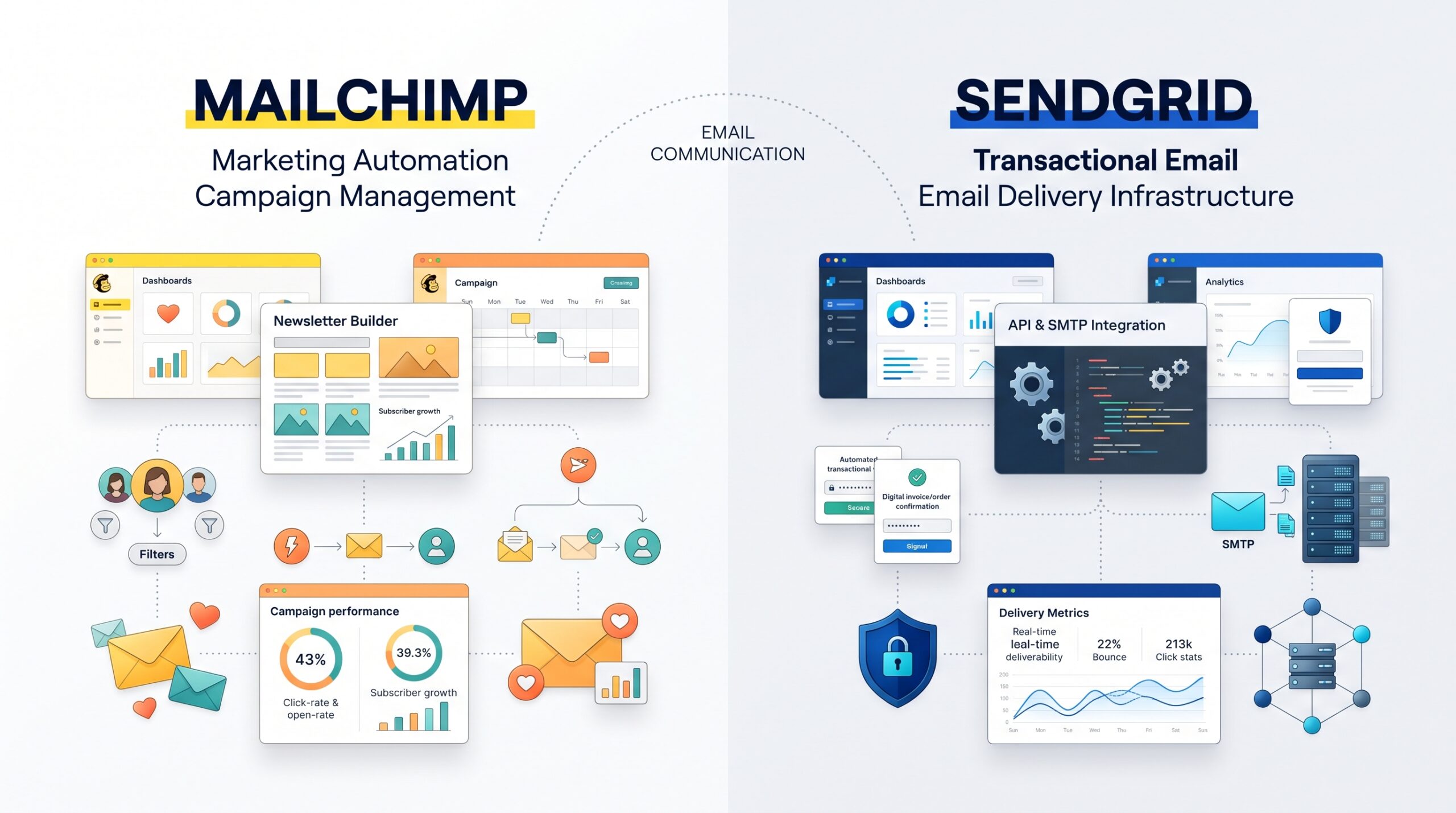
SendGrid also has a Marketing Campaigns product for newsletters and bulk sends, but that is a secondary offering. The core strength remains transactional email infrastructure.
How Do Their Prices Compare?
The pricing models are fundamentally different.
Mailchimp charges mainly by the number of contacts. The free plan covers 250 contacts and 500 emails per month. Essentials starts at $13 per month. Standard starts at $20 per month. Prices rise as your list grows. Transactional email is an extra cost on top of a paid marketing plan (roughly $20 per 25,000 emails).
SendGrid charges mainly by email volume for its Email API. Essentials starts at $19.95 per month for 50,000 emails or $34.95 for 100,000 emails. Pro plans start at $89.95 and include a dedicated IP. Marketing campaigns are priced separately and start around $15 per month for smaller lists.
If you send a lot of transactional email, SendGrid is usually cheaper at scale. If you mainly send marketing campaigns to a contact list, Mailchimp’s model is often more straightforward.
How Do the Features Compare?
| Feature | Mailchimp | SendGrid |
|---|---|---|
| Primary Focus | Marketing campaigns & automation | Transactional email API |
| Starting Price | $13/month (Essentials) | $19.95/month (50k emails) |
| Free Option | 250 contacts, 500 emails/month | 60-day trial (100 emails/day) |
| Transactional Email | Paid add-on (Mandrill) | Core product |
| Marketing Campaigns | Excellent | Available but secondary |
| Automation | Strong (Customer Journeys) | Limited (stronger on higher plans) |
| Developer Experience | Good | Excellent (API-first) |
| Integrations | 300+ | Developer-focused + Twilio ecosystem |
| Dedicated IP | Available as add-on | Included on Pro plans |
Which Is Better for Transactional Email?
SendGrid. This is not particularly close.
SendGrid was built for transactional email. The API is mature, the documentation is strong, deliverability tools are solid, and pricing scales cleanly with volume. Many development teams use it as their default sending infrastructure.
Mailchimp can handle transactional email through its add-on, but it is clearly secondary. You need a higher marketing plan first, and the experience is less developer-centric.
Which Is Better for Marketing Campaigns?
Mailchimp. Again, not close.
Mailchimp’s visual builder, templates, audience tools, automation journeys, and reporting are designed for marketers. SendGrid’s Marketing Campaigns product works, but it does not match Mailchimp’s depth or ease of use for non-technical users running newsletters and promotional sequences.
Who Should Choose Mailchimp?
Mailchimp makes more sense if you:
- Primarily send newsletters and marketing campaigns
- Need strong automation and audience segmentation
- Want a visual editor and easy-to-use interface
- Prefer a free plan that lets you start sending immediately
- Do not need high-volume transactional email from an app
Who Should Choose SendGrid?
SendGrid makes more sense if you:
- Need reliable transactional email (receipts, resets, notifications)
- Have developers who will integrate via API or SMTP
- Send higher volumes of triggered email
- Want dedicated IP options and strong delivery infrastructure
- Already use or plan to use other Twilio products
Can You Use Both?
Yes. Many companies do exactly that. They use Mailchimp for marketing campaigns and SendGrid for transactional email from their application. Used this way, the two tools solve different problems cleanly.
Before You Go – We Have a Gift for You
We put together a free ebook packed with practical tips on earning online and growing your digital income. It is completely free. Just drop your email below, and it lands in your inbox right away.
Frequently Asked Questions
Is SendGrid free?
SendGrid no longer offers a permanent free plan for new accounts. It currently provides a 60-day trial limited to 100 emails per day.
Can Mailchimp replace SendGrid?
For light transactional needs, yes. For serious application-triggered email at scale, most teams prefer SendGrid or a similar API-focused provider.
Can SendGrid replace Mailchimp?
For basic marketing campaigns, yes. For advanced automation, visual campaign building, and marketer-friendly tools, Mailchimp is generally stronger.
Which has better deliverability?
Both can deliver well when configured properly. SendGrid is often preferred for high-volume transactional email because of its infrastructure focus and dedicated IP options on higher plans.
The Bottom Line
Mailchimp wins for marketing teams that need campaigns, automation, and audience tools.
SendGrid wins for developers and product teams that need reliable transactional email delivery at scale.
They are not true competitors in most cases. They solve different jobs. Choose the one that matches the type of email you actually need to send, or use both if your business requires both marketing and transactional email.