ClickFunnels vs Kajabi: Which Platform Is Actually Worth Your Money
ClickFunnels vs Kajabi comes up constantly in online business conversations, and most comparisons end the same way: a generic table, some hedging, and a conclusion that avoids actually telling you anything.
So here is a straight answer instead.
Quick Answer: ClickFunnels is built for sales funnels, conversion pages, and driving cold traffic into purchases. Kajabi is built for course creators, coaches, and digital educators who need a full learning management system. ClickFunnels starts at $97 per month. Kajabi starts at $179 per month. If the funnel is the business, pick ClickFunnels. If the course is the business, pick Kajabi.
They are not really competitors in the way most articles frame them. They serve different people with different needs. Once you understand that, the decision gets a lot easier.
What Is ClickFunnels?
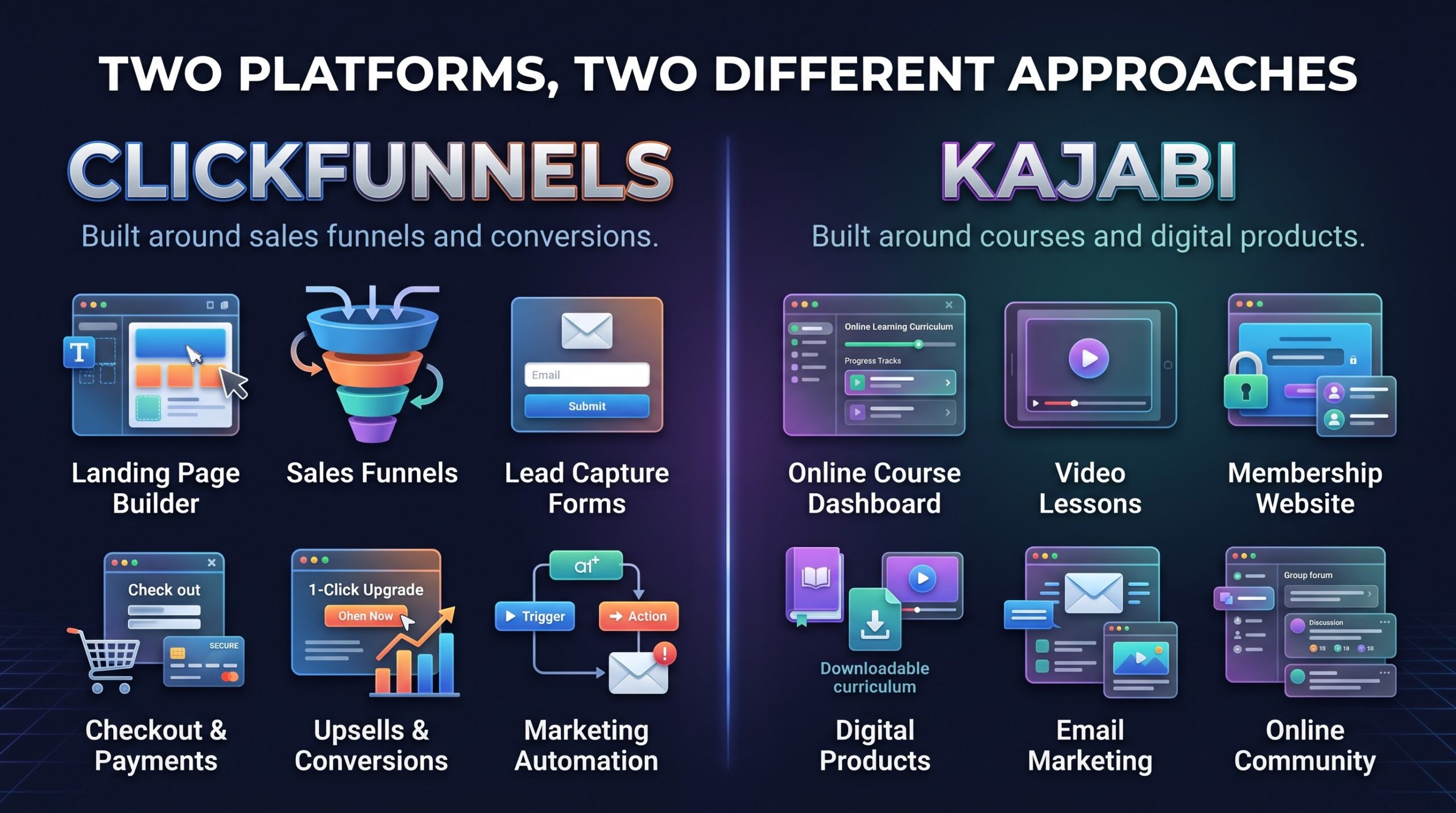
ClickFunnels is a sales funnel builder that lets you create high-converting landing pages, order forms, upsell sequences, and checkout flows without needing a developer or a separate email platform. It was built by Russell Brunson in 2014 around one idea: most businesses do not have a traffic problem, they have a funnel problem. The platform is designed to fix that.
It is used heavily by affiliate marketers, course sellers, ecommerce stores, coaches, and anyone running paid traffic campaigns. The funnel builder is genuinely excellent. The A/B testing tools, one-click upsells, and order bump features are where ClickFunnels has always been strongest, and that has not changed.
What Is Kajabi?
Kajabi is an all-in-one platform for creators who sell knowledge. It combines course hosting, community features, email marketing, membership sites, coaching programs, and podcasting tools into one dashboard. If you are selling what you know, whether that is a fitness program, a design course, a coaching package, or a membership community, Kajabi is built around that business model in a way ClickFunnels is not.
It launched in 2010, a few years before ClickFunnels, and has stayed focused on the creator economy rather than branching into pure funnel building. The course delivery experience inside Kajabi is substantially better than anything ClickFunnels offers on that front.
How Do Their Prices Compare?
Pricing is where people get tripped up because both platforms have changed their plans multiple times. Here is what they look like in 2026.
ClickFunnels runs four tiers: Launch at $97 per month, Scale at $197, Optimize at $297, and Dominate at $5,997 per year. On annual billing the lower plans drop to roughly $81, $164, and $248 per month. All plans include unlimited funnels and no transaction fees taken by ClickFunnels itself. You still pay payment processor fees on top of that.
Kajabi’s plans start at $179 per month for Basic, $249 for Growth, and $499 for Pro on monthly billing. On annual billing those come down to around $143, $199, and $399. The catch: Kajabi charges a surcharge (up to 2% on Basic, lower on higher plans) when you use a third-party processor like Stripe instead of Kajabi Payments. That adds up fast if you are doing volume.
ClickFunnels is cheaper across every tier and avoids the transaction fee issue entirely. But comparing sticker prices alone misses the point. Kajabi’s higher price includes course hosting, a full LMS, email automation, community tools, and membership management that ClickFunnels does not include at the same depth.
How Do the Features Compare?
| Feature | ClickFunnels | Kajabi |
|---|---|---|
| Starting Price | $97/month | $179/month |
| Free Trial | 14 days + 30-day money back | 14 days + 30-day money back |
| Sales Funnel Builder | Excellent, unlimited funnels | Basic pipeline builder |
| Course/LMS Tools | Basic, limited features | Full LMS with quizzes, certificates, mobile app |
| Email Marketing | Native, good automation | Built-in, strong segmentation |
| A/B Testing | Yes, native | Limited |
| Community Features | Basic | Built-in community and spaces |
| Affiliate Management | Higher plans | Growth plan and above |
| Membership Sites | Basic | Full, with paywall tiers |
| Transaction Fees | None from ClickFunnels | 0.5–2% on third-party processors |
| Mobile Student App | No | Yes (higher plans) |
Which Is Better for Building Sales Funnels?
ClickFunnels. It is not particularly close.
The funnel builder in ClickFunnels is what the entire platform was designed around. You get unlimited funnels, one-click upsells and downsells, native A/B testing, order bumps, scarcity timers, and a template library built specifically for conversion. Everything in the interface is oriented toward getting someone from a landing page to a purchase as efficiently as possible.
Kajabi has a pipeline builder that handles simple sales paths, and it works well enough for a course launch or webinar funnel. But it does not have the depth of conversion tools that ClickFunnels offers. If you are running cold paid traffic and testing multiple funnel variations, Kajabi is going to feel limited quickly.
For anyone building their first funnel or using paid ads to scale, ClickFunnels is the better tool. Our post on how to build a high ticket sales funnel goes into the funnel building process in detail if you want a practical breakdown of what that looks like.
Which Is Better for Selling Online Courses?
Kajabi. Again, not close.
The learning management system inside Kajabi is a full product. You get module-based course structures, drip content scheduling, quizzes and assessments, completion certificates, lesson-level discussions, a student mobile app, and engagement tracking across all of it. Students can learn on their phone, track progress, and interact with course content in a way that feels professional.
ClickFunnels has bolted on a basic course delivery tool, but it is clearly not the focus. There are no quizzes, no in-lesson discussions, and no student progress tracking worth mentioning. It can host a course, but it cannot deliver one in a way that creates a good learning experience.
If someone is paying you for a course, the experience they have inside that course matters for refund rates, testimonials, and whether they buy from you again. Kajabi takes that seriously in a way ClickFunnels does not.
Which Has Better Email Marketing?
This one is closer, but Kajabi edges ahead for most users.
Both platforms include native email marketing. ClickFunnels has solid automation workflows, broadcast emails, and basic segmentation. Kajabi’s email tools are comparable in features but tend to get better reviews for the builder experience and the depth of its automation rules. Kajabi also includes email marketing on all plans without requiring an upgrade, and the tagging and segmentation options are more granular.
Neither platform will replace a dedicated email tool like ActiveCampaign for very complex automation. But for the majority of course creators and funnel builders, both are more than capable.
Which Platform Is Easier to Use?
Kajabi tends to get better marks for ease of use, particularly for non-technical people. The setup paths are more guided, the dashboard is less overwhelming, and it is designed around a creator workflow that feels intuitive if you are coming from a teaching or coaching background rather than a marketing one.
ClickFunnels is not hard to use, but it is clearly built for marketers. The funnel-first approach means you are thinking in terms of pages, steps, and conversion actions from day one. That is natural for someone who has run funnels before and confusing for someone who just wants to sell a course to their audience.
Both have 14-day free trials and 30-day money back guarantees. Worth testing both inside that window before committing.
Who Should Choose ClickFunnels?
ClickFunnels makes more sense if you are:
- Running paid traffic to landing pages and optimizing for conversions
- Building a business around sales funnels with upsells, downsells, and order bumps
- Doing affiliate marketing and need clean, fast landing pages
- Testing multiple funnel variations with A/B split tests
- Selling physical or digital products and need strong checkout features
- On a tighter budget and do not need a full LMS
ClickFunnels is the right call when the funnel is the product. When your business is about moving people from cold to converted as efficiently as possible, this is what it was built for.
Who Should Choose Kajabi?
Kajabi makes more sense if you are:
- Selling online courses and need a proper student experience
- Running a coaching or consulting business with membership content
- Building a community alongside your paid content
- A creator or educator who wants everything in one place
- Selling recurring memberships with different access tiers
- Not particularly technical and want a guided, all-in-one setup
Kajabi is the better fit when the content is the product. If people are paying you to learn something, the platform they learn on reflects on you. Kajabi makes that experience professional without requiring you to stitch together five different tools.
Can You Use Both Together?
Yes, and some people do. A common setup is using ClickFunnels to run the top of funnel, capturing leads and making the initial sale, then delivering the course content through Kajabi.
It adds cost and some technical complexity around integrations, but it gives you the best conversion tooling from ClickFunnels alongside the best course delivery from Kajabi. Whether that is worth the extra subscription depends on your volume and how much the conversion optimization matters at your current stage.
For most people just starting out, pick one based on your primary business model. Add the other later if you actually need it.
Before You Go – We Have a Gift for You
We put together a free ebook packed with practical tips on earning online and growing your digital income. It is completely free. Just drop your email below and it lands in your inbox right away.
Frequently Asked Questions
Is ClickFunnels or Kajabi better for beginners?
Kajabi is generally easier to get started with, especially for creators and educators. The interface is more guided and the setup paths are cleaner. ClickFunnels has a shorter learning curve for people who already understand funnel marketing, but can feel complex for someone brand new to online business.
Can Kajabi replace ClickFunnels?
For simple funnels, yes. Kajabi’s pipeline builder handles basic sales paths like a webinar funnel or a course launch sequence well enough. But it cannot match ClickFunnels for advanced conversion tools like native A/B testing, one-click upsells, and deep order form customization. If funnels are core to your business, Kajabi is not a full replacement.
Can ClickFunnels replace Kajabi?
For course delivery, no. ClickFunnels can host a basic course, but it lacks the quizzes, progress tracking, student mobile app, and community features that Kajabi includes. If you are selling learning experiences, ClickFunnels falls short as a standalone course platform.
Does ClickFunnels have transaction fees?
ClickFunnels does not take a cut of your sales. You still pay standard payment processor fees through Stripe or PayPal, but ClickFunnels itself adds no transaction fee on any plan. Kajabi charges 0.5% to 2% on third-party processors depending on your plan, dropping lower if you use Kajabi Payments.
Which is better for high ticket offers?
ClickFunnels is generally stronger for selling high ticket offers through a sales funnel, particularly if you are using paid ads and a VSL plus application funnel structure. Kajabi works well for high ticket coaching programs where the delivery experience and community matter as much as the initial conversion. The right answer depends on whether you are optimizing for the sale or the student experience after the sale.
The Bottom Line
ClickFunnels wins for funnel builders, paid traffic marketers, and anyone whose business is built around converting strangers into buyers as efficiently as possible.
Kajabi wins for course creators, coaches, and educators who need a polished student experience, a built-in community, and everything managed in one place without stitching tools together.
The mistake most people make is treating them as interchangeable. They are not. Pick based on your business model, not based on which one has a shinier sales page or a bigger affiliate commission attached to the review you are reading.